
Origins and Early Design Goals
In 2015, MX3D team announced a bold proposal: to 3D print a fully structural metal bridge in the centre of Amsterdam. More than a decade later, the MX3D Bridge remains one of the most discussed real‑world demonstrations of large‑scale metal additive manufacturing, and an important case for artists, designers, and architects seeking to understand how digital fabrication can reshape physical space.
Project Evolution: A Collaboration between Design, Engineering, and Technology
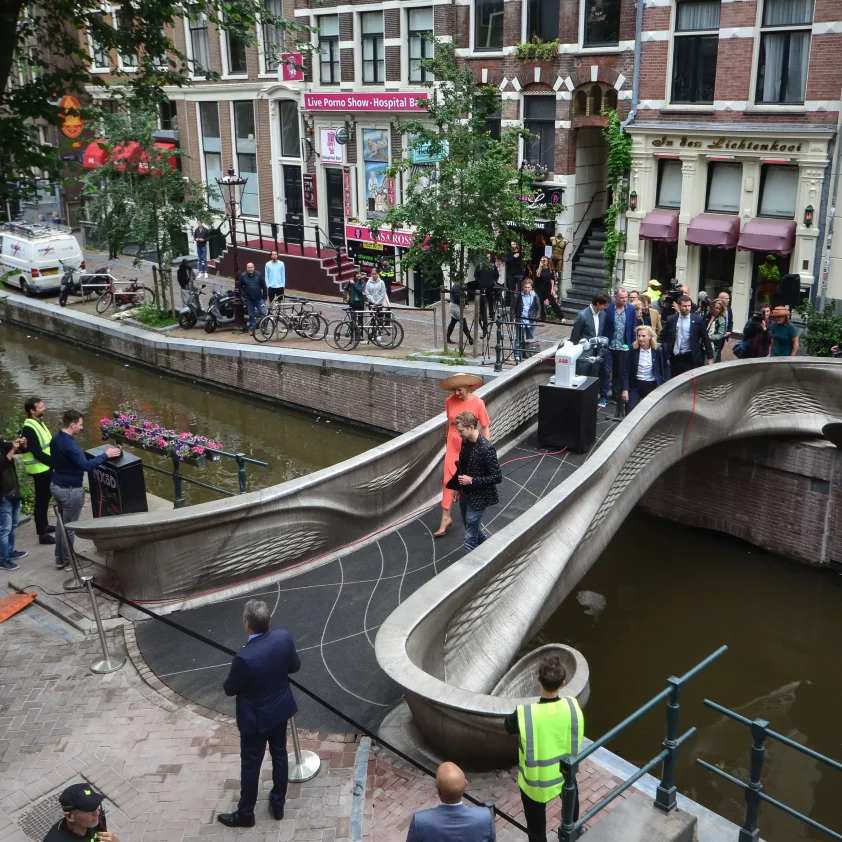
The futuristic, multi-award-winning MX3D Bridge, designed by Joris Laarman Lab with Arup as lead engineer, spans one of the oldest canals in Amsterdam’s Red Light District. The project was made possible through funding from the Lloyd’s Register Foundation and collaboration with industry leaders including ABB, ICL, Air Liquide, ArcelorMittal, Autodesk, AMS Institute, and Lenovo, all of whom helped MX3D realize its ambitious vision.
Between 2017 and 2018, four robots 3D-printed the bridge using over 6,000 kilograms of stainless steel. While initial plans included printing the bridge in place over the canal, practical and safety considerations (such as potential harm from welding light to bystanders) led the team to fabricate it in controlled facilities before transporting and installing it on site.
After several years of design, testing, and printing, the bridge was installed and formally opened in July 2021, with Queen Máxima of the Netherlands attending the ceremony, a landmark moment that brought 3D printing into the conversation of global public infrastructure. The installed structure spans approximately 8.7 metres, and the City of Amsterdam granted MX3D a two-year permit to use it as a real-world experimental prototype, allowing the city to monitor its safety and performance before considering permanent use.
Smart Infrastructure and Data Integration
The MX3D Bridge is designed as a living laboratory, combining advanced design with a state-of-the-art sensor network to explore how IoT can shape the built environment. It enables research into topics such as crowd behaviour, tourism impact, open data, and data ethics.
A sophisticated sensor system collects real-time structural and environmental data, including strain, load, displacement, vibration, air quality, and temperature. These data streams feed into a digital twin, a real-time virtual model of the bridge, allowing engineers to monitor its performance, assess structural health, and track how it evolves over time.
Beyond monitoring, the system enables the bridge to “learn” from usage, beginning with tracking pedestrian flow and movement. This integration of physical infrastructure and data-driven modelling demonstrates how architecture can evolve beyond static form into an interactive platform for research and innovation.
A New Touch Point for Design and Architecture
From a design and architecture perspective, the bridge is notable for its form and material character. The bridge’s geometry was developed through computational design, enabling unique sculptural forms and spatial rhythms that would be difficult to create with conventional methods. The bridge’s surface retains evident traces of its fabrication process, articulating a productive tension between raw industrial fabrication and elegant urban design. For artists and designers interested in materiality and process visibility, this is a significant touchpoint.
Ready to explore more about WAAM for your Art & Design Project?
To explore more about the intersection of robotic metal printing and creative design, or to see if your concept and projects can be brought to life, visit the following links:
Curious about having a sample box to explore our printing materials more closely?