
We are excited to share the outcome of our recent activity within the Tracks4Crafts project: a two-week residency at MX3D ArtLab exploring the creative potential of Wire Arc Additive Manufacturing (WAAM) for art, design, and architecture.
This residency brought together digital fabrication, material experimentation, and artistic exploration: using robotic metal 3D printing as a medium for creative expression.
A Hybrid Craft in the Making
As part of Tracks4Crafts’ “Forging a Hybrid Craft for Metals”, MX3D ArtLab explores WAAM as more than a manufacturing technology: it is also an emerging craft practice that brings together traditional metalworking and digital fabrication.
WAAM combines established welding processes with robotic fabrication, digital modelling, process preparation, and computational design. This makes it a truly hybrid craft, requiring both embodied metalworking knowledge and new digital skills.
Through this initiative, MX3D ArtLab helps shape the WAAM designer/operator role as a craft practice — making this knowledge more accessible, shareable, and transferable across craftspeople, designers, engineers, and researchers.
By testing training formats, knowledge exchange, and practical applications, the project explores how craftsmanship and new technologies can strengthen each other.
Residency Programme
For this edition, artist Momamu_Lab joined MX3D ArtLab for a two-week residency in Amsterdam.
The programme combined technical onboarding into WAAM, hands-on design exploration, iterative prototyping & validation, and a full-scale robotic metal printing.
Working closely with the MX3D ArtLab team, the artist explored how WAAM can be used as a sculptural and expressive medium, balancing design intention with the technical constraints of robotic fabrication.
Experimental WAAM Artefact
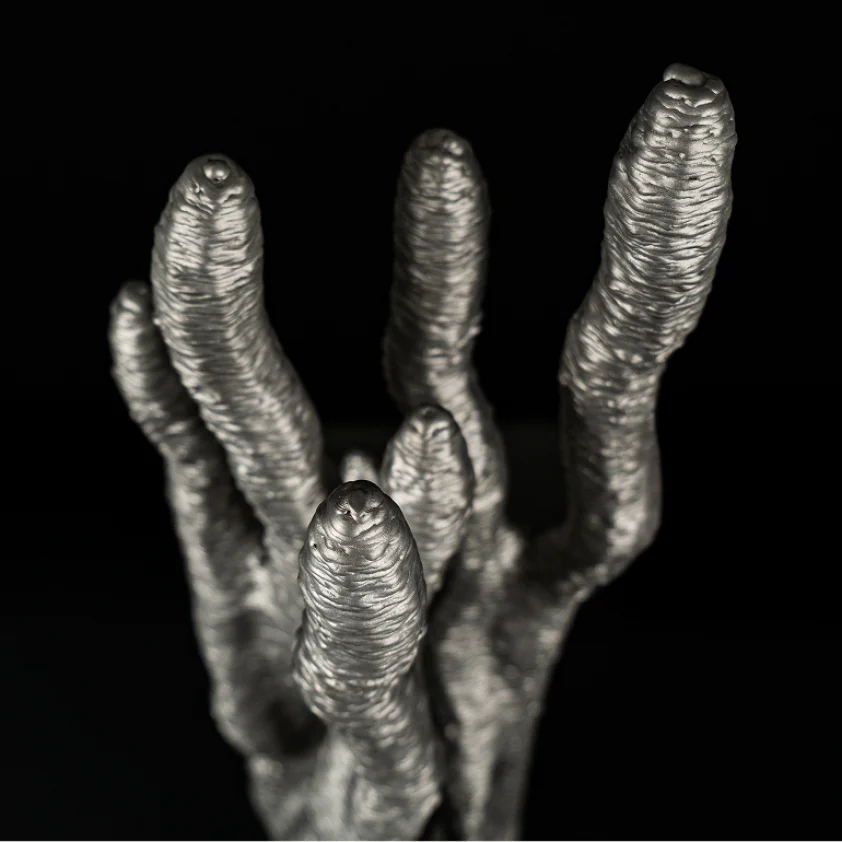
Through rapid ideation and physical prototyping, the design direction evolved into a coral-like organic structure, characterised by upward growth and fluid form.
After iterative optimisation for printability, the final design was fabricated using MX3D’s MetalXL software, which controls robotic toolpaths, kinematics, and process monitoring.
The result is a single stainless steel artefact, produced in one continuous print over multiple days.
The piece demonstrates how WAAM enables complex geometries and rich material expression that would be difficult to achieve through conventional manufacturing methods. At the same time, it opens up hybrid possibilities between functional objects and sculptural work — such as lighting or spatial objects.
Expanding the Possibilities of WAAM
Beyond this project, MX3D ArtLab continues to explore new possibilities for Wire Arc Additive Manufacturing (WAAM) in art and design. Ongoing research focuses on innovative material combinations, the dynamic relationship between surface, structure, and texture, and the creative potential of diverse post-processing techniques.
By experimenting across these areas, MX3D ArtLab is expanding the boundaries of WAAM beyond its established industrial role, developing a richer and more expressive design language. This work creates new opportunities for artists, designers, and researchers to rethink how materials are used, experienced, and shaped for the future.
Join the Exploration
This residency is part of our ongoing effort to build a broader ecosystem around WAAM as a creative and technical craft.
If you are interested in exploring WAAM-based design and artistic applications, collaborations in research, education, and experimentation, or simply would like to exchange knowledge around digital fabrication and metal craftsmanship, reach out to us. We would love to connect and explore new possibilities together.
👉 Want to know more about tracks4crafts? Visit the project space at tracks4crafts.eu
Ready to Explore WAAM for Your Art & Design Project?
To explore more about the methods, intersection of robotic metal printing and creative design, or to see if your concept and projects can be brought to life, visit the following links:
Curious about having a sample box to explore our printing materials more closely?