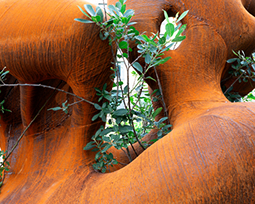
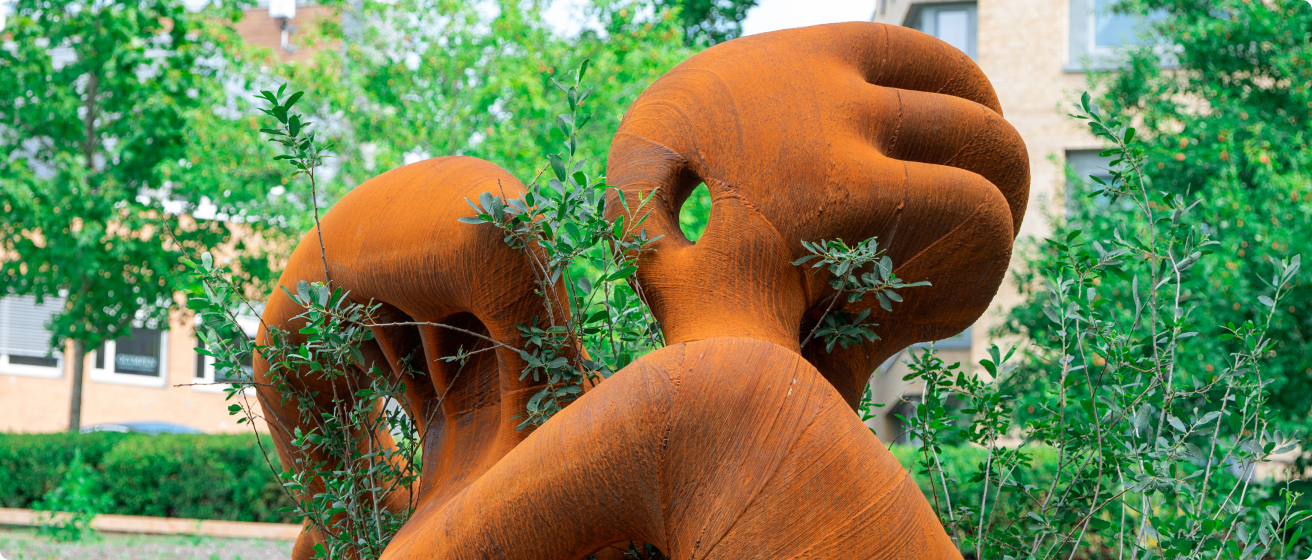
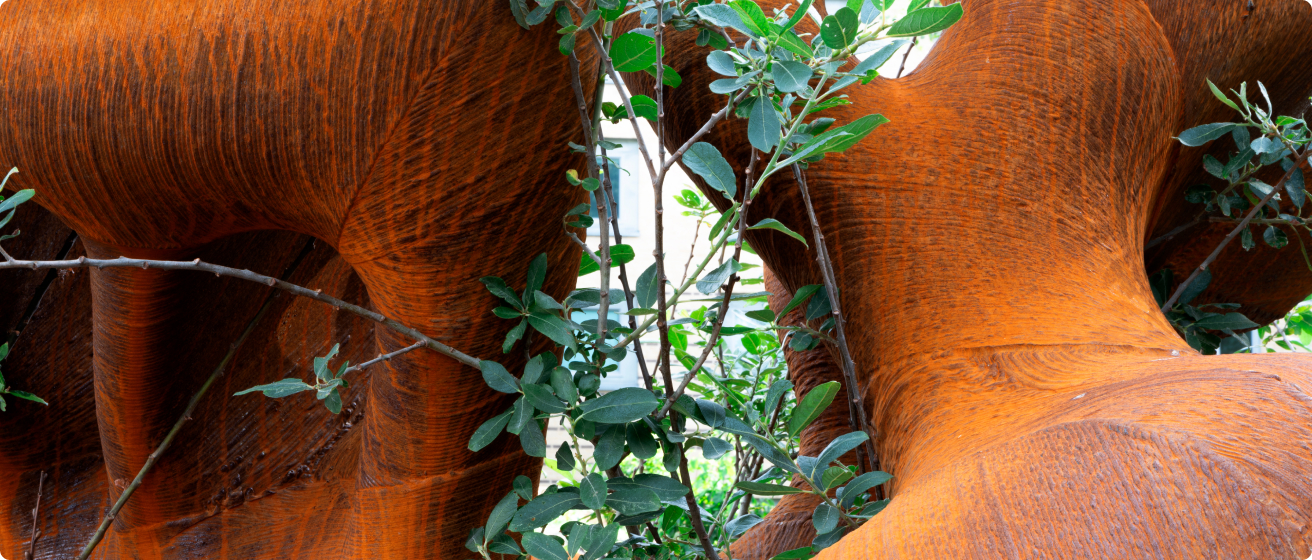
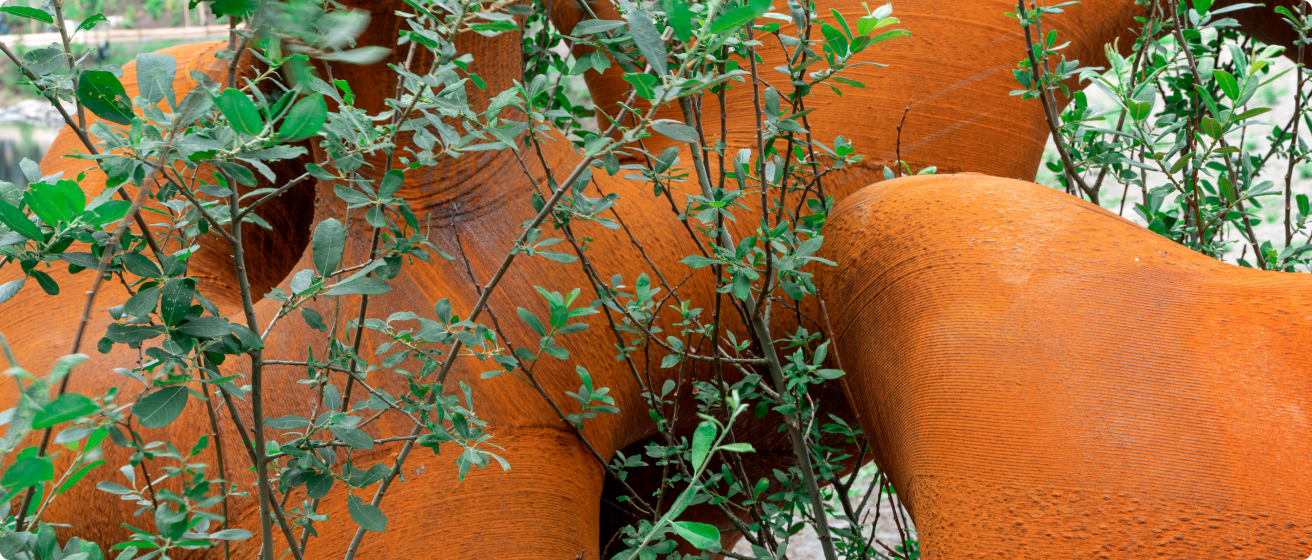
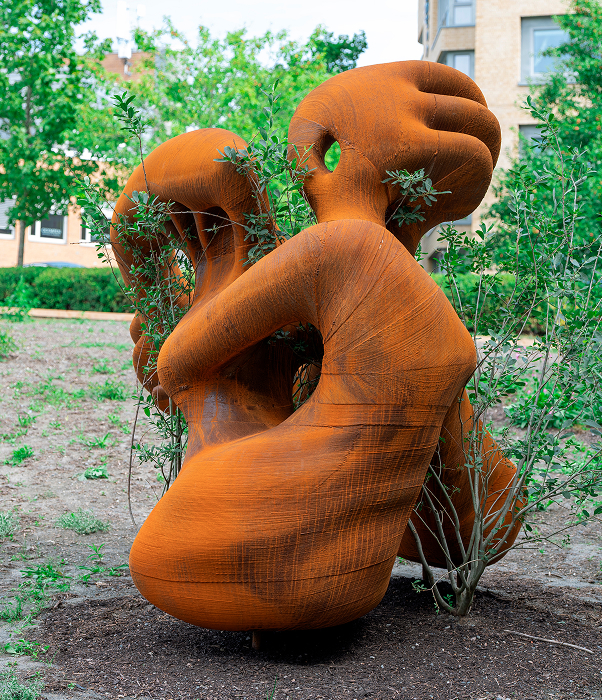
At the Life Science Building at the University of Oslo, Formdannelse (Taking Form) brings together an abstract corten steel figure, living willow trees, and shifting shadows.
ABOUT THE PROJECT
Formdannelse (Taking Form) is a site-specific sculpture by artist Toril Johannessen, installed at the Life Science Building at the University of Oslo, commissioned by KORO.
Measuring approximately 2 × 2 × 2 metres and weighing around 570 kilograms, the sculpture was entirely 3D printed in corten steel with WAAM. Its abstract geometry can suggest a human or animal figure, depending on the viewer’s position.
THE STORY BEHIND
The work explores the relationship between static, human-made form and living, changing matter. Its title refers to morphogenesis, the biological process through which organisms develop their shape, connecting the artwork to the context of the Life Science Building.
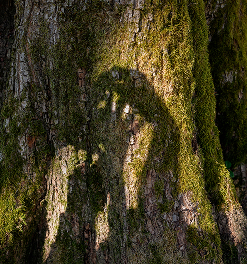
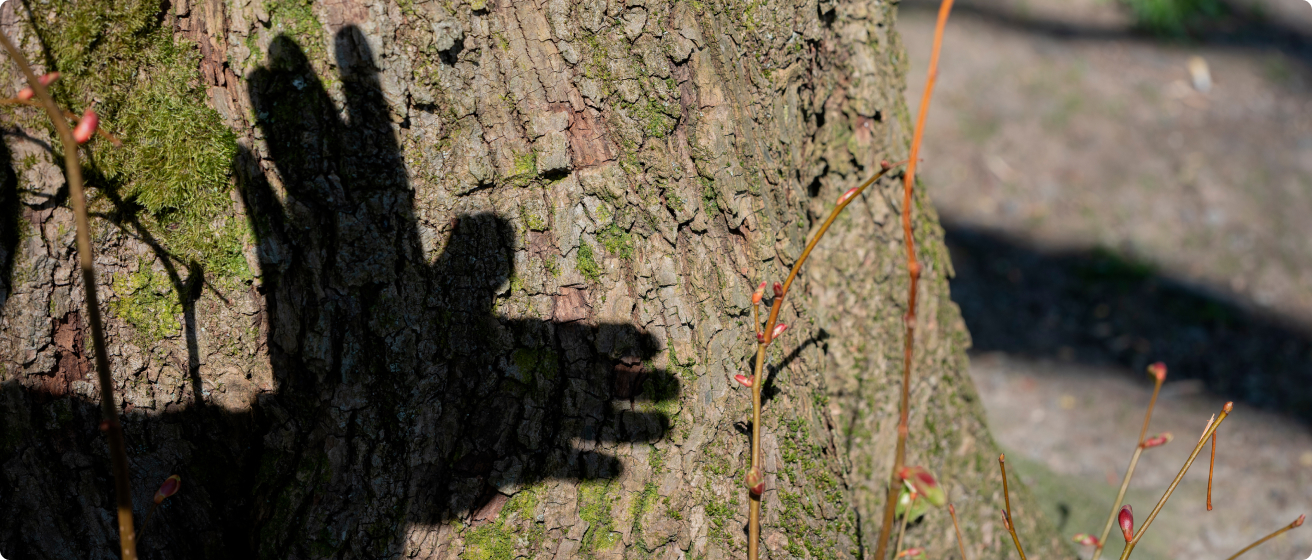
The form of the sculpture originates from shadows created by human hands. These fleeting shapes were translated into a permanent three-dimensional figure, while the original shadows remain hidden within the sculpture’s geometry.
At specific times of day in the middle of the summer, sunlight reveals these forms again. Around 9am, the shadow can suggest hands, fingers, and a skull; around 5pm, it can resemble a bird with outstretched wings.
As the willow trees grow, these shadows will change with them, making the artwork an evolving composition of form, light, and nature.
REALIZATION
Formdannelse (Taking Form) was robotically 3D printed in corten steel using MX3D’s Wire Arc Additive Manufacturing (WAAM) technology. Its complex geometry includes significant overhangs that would be challenging to produce with conventional 3D printing. With MX3D’s 8-axis robotic system, the forms could be printed directly without support structures, tooling, or expensive moulds.
The sculpture was printed in several pieces and assembled afterwards. Approximately 570 kilograms of material were deposited with virtually no waste, and the entire fabrication process was completed in just over one month.
FREEDOM OF WAAM
The freedom of WAAM allowed the complex organic geometry to be fabricated directly from its digital design, while the characteristic layered surface of the printing process remains visible in the finished work. These traces became an integral part of the artistic concept, echoing a process of growth, formation, and emergence.
“How does a cell, an organism, a body, a tree, a house, a landscape, or a work of art find or receive its form? Thoughts about how form emerges have been central to this work from the very beginning — from the scientific concept of morphogenesis to the artistic process of giving shape to something imagined.
That is why it was especially exciting and meaningful to collaborate with MX3D on the production of the sculpture Taking Form. The technique of printing in steel made it possible to realize the sculpture’s organic form the way it was conceived. The rough surface, with its visible welding threads, reveals how the form is built up — thread by thread, part by part — giving the sculpture an expression that corresponds with my underlying idea.
I contacted MX3D early in the project, at a point when I knew very little about the production method. I was met with thorough, generous guidance and an openness to my artistic process. In this artwork, taking form concerns a tension between shaping according to delimiting principles and constructive constraints, and shaping freely and imaginatively. Working with MX3D ensured a good balance between these two sides also in the production process: the technical demands of the printing process gave the work a set of real, material constraints to respond to, yet those constraints never closed off the organic, imaginative form I had envisioned.”
——Toril Johannessen
CREDITS
Artwork by ©Toril Johannessen
Commissioned by ©KORO
Realised in collaboration with ©Aldea, Bergen
Photos by ©Toril Johannessen